
For IMGs drowning in resource lists. I have tried nearly every resource that exists for these exams, and 15 of them mattered.
By Dr. Marish Asudani · Published · Updated
Across all 3 Steps, I use 5 resources per exam, in the order I used them. Step 1: the Neil Randy HY PDF, Mehlman Medical, the First Aid Guide on USMLE Vault, the Foundation Anki and NBME Booster decks, and Sketchy Micro with Dirty Medicine. Step 2 CK: 1 notes set, UWorld, AMBOSS, Divine Intervention, and CMS Forms 3–10 plus NBMEs 9–16. Step 3: the Biostats PDF and Anki deck, AMBOSS High Yield Study Plans, Mehlman micro and pharm, the 90-page HY PDF, and CCS cases. Almost all of it is free.
If you only want the list, this is it. Most of these work for both exams. Each one links to where I explain how and when to use it. The full 5-per-exam stack is below.
Good not just for Step 1 but for Step 2, because he has playlists for both. Free playlists, and literal gold mines. They teach you how the NBME thinks about answers. For Step 1, watch the system's playlist in every system, right after the First Aid Guide.
For when a concept simply won't click. Foundation work early in prep: psychiatry, ethics, biochemistry.
First Aid decoded page by page with MCQs on every page, both Anki decks, the free PDFs, the assessments and your schedule, in one place.
Step 2 CK. Fast high-yield consolidation once your reasoning is in place, about 3 weeks.
Step 2 CK. Fast morning recall, paired with the Divine Intervention episodes the night before.
His whole library, system by system, not just biostats. Run it right before an NBME and again before the exam.
There's one for Step 1, built from NBME 20 to 34 and the Free 120, and one for Step 2 CK, built from NBME 9 to 16 and the Free 120. The NBME keeps asking the same concepts, and the Booster turns them into cards. It's for the last stretch, when you need points rather than content.
The episodes worth your time, not all of them. A Step 1 PDF and a Step 2 CK last-month PDF.
Every concept on this exam is explained somewhere for free. The problem was never the videos — it's knowing which one, and where it fits. That's the entire list below.
Everyone thinks Neil Randy is only good for biostats, and almost nobody works through his full channel — which is exactly the edge. I built a high-yield PDF breaking his entire library down system by system, so you can run his important videos right before an NBME or your exam.
It's not just biostats. Cardiovascular, CNS, psychiatry, ethics, biochemistry. This alone moved my scores, and my students', by 5 to 10%.
Short, dense, system by system, free, and not even close to second place. He doesn't teach you the answer — he teaches you how the examiner thinks, builds the trap in your mind, then shows you how to eliminate it.
2 rules. Watch the videos, not just the PDFs — the gold is in the videos. And watch him in every system: after the First Aid Guide, before the FA Foundation Anki and UWorld, about 1 day per system. Short on time? Sort his playlist by date and watch the last 3 years first.
First Aid was written to remind, not to teach. The Guide decodes it page by page — all 646 pages. Every page opens with what's actually tested from it, gets a plain-English explanation with an analogy, then MCQs on that exact page so you test the second you read.
That last layer is the one that matters: it's what primes you for UWorld. Same block, same brain — 48% cold becomes 70% primed.
Read 1 system the Guide way, freeFirst Aid Guide · Renal: what each page tests, the ELI5 and the MCQs on that exact page.
Open Renal free →2 decks, 2 completely different jobs. Neither is a 30,000-card monster.
Foundation Anki — 2,499 cards (as of October 2026), a page-by-page aggregation of the whole of First Aid, with the page number on every card. At ~400 cards a day that's a full First Aid pass in 5–6 days. Use it system by system, and when a card makes you hesitate, open that exact page.
NBME Booster — NBME 20 to 34 and the Free 120, for the last stretch, when you need points rather than content. This is the one for the ceiling you can't break through. How it works →
Sketchy Micro is your foundation week: ~85 bugs in 6 days, about 20 a day, video then PDF — and the same night, that day's MCQs. Watch then test, same day. That's why it sticks.
Dirty Medicine is the one for when a concept simply won't click. Where Mehlman and Neil Randy are revision resources, Dirty Medicine builds the foundation early — psychiatry, ethics, biochemistry, anything giving you trouble.
My team and I went through First Aid page by page and mapped the best video on YouTube to each topic that needs one — sometimes Mehlman, sometimes Neil Randy, sometimes Dirty Medicine — and linked it right on the page, with that page's MCQs beside it. You never go hunting again. That's usmlevault.com, and it's free for your first 3 days.
Want a day-by-day schedule that tells you exactly what to study next? The Vault builds it around your exam date.
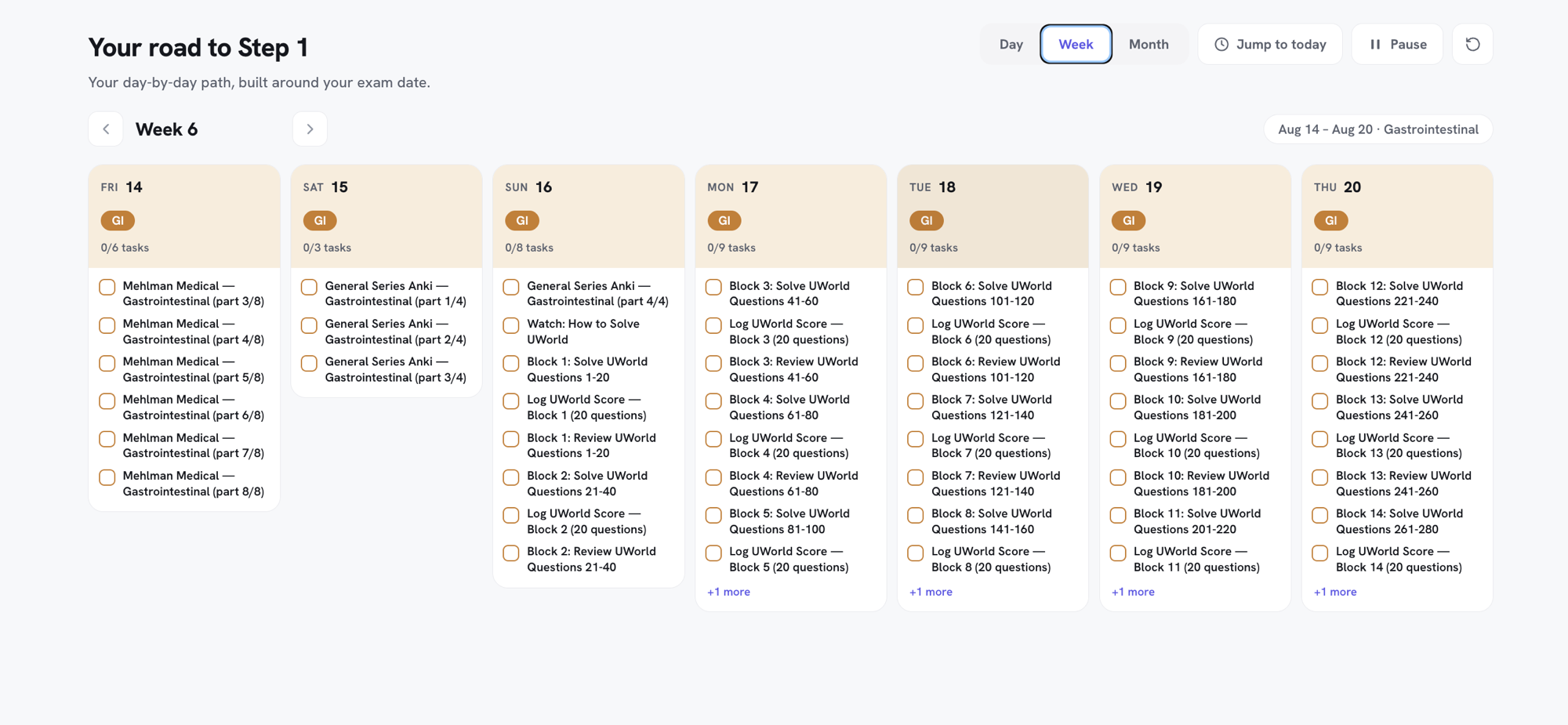 Build my schedule on usmlevault.com/schedule →
I scored 254 in 5 months. My highest student scored 269. Before the list, the mistake that costs people 2 months: starting UWorld before choosing a notes set. Questions go in, knowledge leaks out, because there's no anchor holding it.
In Step 1 everyone knows the answer is First Aid. In Step 2 students are genuinely clueless about what to revise from, and that confusion wastes months.
Targeting 250: Marish's Annotated First Aid — your Step 1 layout, with the clinical layer Step 2 tests added on top. 16–20 weeks.
Targeting 260+: Inner Circle Notes — denser, deeper, all major systems. 6 months minimum.
Pick one and never switch. Not at month 3 because someone on Reddit recommended something else.
Phase 1 is the real learning, and it runs about 3 and a half months. The rule that makes it work: after every wrong answer, the correction goes into your notes. Blocks without that step are half the work — the notes review is where retention actually happens.
UWorld's biostats coverage is not sufficient for Step 2. Use AMBOSS for biostats and ethics specifically, early. Then in your final month: the 200 High-Yield Concepts, vaccines, risk factors, quality improvement and communication.
Order matters. Run the 200 concepts in the last month and they stick. Run them first and you'll forget every one.
The podcast is enormous and most of it isn't your priority. So I built 18 episode guides, one per system — the exact episodes worth your time for that system, as interactive HTML you can download. Free, no email.
Use them the night before you review a system. Pair with Dr. High Yield for fast morning recall.
The closest thing to the real exam that exists, and where 240s become 250s. 2 rules: review them far harder than you attempt them, and don't touch CMS forms until UWorld is finished — otherwise you're guessing on systems you haven't studied yet.
Take every NBME offline. The online version gives you 50 questions in 75 minutes, which is roomier than the real exam and inflates your score by 4 to 6%. Why offline →
Which ones predict: the trend on NBME 13, 15 and 16, plus the Free 120, which is the most predictive. What I've seen: 80%+ on the Free 120 means a good chance of 250+.
Underneath all of it, the rule that pays for itself: a full notes cycle before every single NBME. Students who skip it score 5–10 points below their actual ability. Every time.
The Step 2 CK NBME Booster AnkiNBME 9 to 16 and the Free 120, turned into cards, system by system. Opens straight into the deck.
Open the Step 2 deck →I scored 230 in 25 days. My highest student, 249, and a 100% pass rate so far — including people with multiple prior failed attempts. Before the list, the correction that saves the most time: UWorld should not be your primary Step 3 resource. The question style and emphasis are genuinely different, and students who lean on it exclusively are consistently surprised by the exam.
Biostatistics is the single most tested topic on Day 1. 7 days: the PDF days 1–3 for the conceptual framework, the Anki deck alongside it for recall, AMBOSS days 4–7.
Then 20 AMBOSS biostats questions every single day until your exam. Never stop that block. And accept this now — no matter how well you prepare, it will still feel hard in the exam. That's by design. Prepare the framework and walk in calm.
Study Plans → High Yield Study Plans → High Yield Study Topics. Work Biostatistics, Ethics, Quality Improvement and Communication — roughly 400–450 questions.
Then the Drug Advertisements section, which almost everyone skips. Every Day 1 block contains at least one drug ad question: a fictional advert with data, graphs and fine print to interpret. Predictable format, completely solvable — and completely disorienting if you've never seen one.
With First Aid open at the same time, not afterwards. Micro is clinical and antimicrobial-heavy here — 3–4 days. Pharmacology runs system by system, 2–3 systems a day, 11 systems, only 3–4 pages each in First Aid — 5–6 days.
Watch the antimicrobial video during this phase, then again in your final week. It's the one resource that earns 2 passes.
Day 2 is Step 2 content reorganised — your job is to fill the gaps that appeared since. Budget no more than 2 days per system across 10–11 systems, roughly 3 weeks.
The 90-page PDF is your primary content. Divine's system guides go the night before each system; Dr. High Yield handles fast morning recall. Same pair I lean on for Step 2 — they carry straight over.
CCS is unlike anything else on the exam and it's where people gain or lose real ground. It's scored on the sequence and appropriateness of your decisions, not the final answer.
First pass: start with the least high-yield cases, 20–30 of them. You're learning the simulator, not the medicine. Write nothing down.
Second pass: 2–3 line notes per case — what you missed, what you ordered out of sequence. Those notes become your night-before material for Day 2.
And the timing rule most guides get backwards: do not start CCS until your NBME scores are ready. NBME 7 is your go/no-go — above 210, with 5 minutes to spare in each block. Then CCS begins, 4–8 weeks out. Not before, and not later.
Read down the column and you'll notice the same 4 jobs repeating. That's not a coincidence — it's why the stack shrinks each time and why running the 3 exams back to back is easier than spacing them out.
| Job | Step 1 | Step 2 CK | Step 3 |
|---|---|---|---|
| Your anchor | First Aid + the Guide | Annotated FA or Inner Circle | 90-page HY PDF |
| The question engine | UWorld + page-by-page MCQs | UWorld tutor mode | AMBOSS HY plans |
| The video layer | Mehlman, every system | Mehlman + Divine guides | Mehlman micro & pharm |
| The verdict | NBME 31, 32, 33 trend, 68%+ on all 3 | NBME 13, 15, 16 trend + the Free 120 (most predictive) | NBME 7 at 210+ |
Which is the real argument for speed. Every extra month between exams is a month your last exam's content decays before the next one needs it. I did all 3 in 11 months: 2 of my students have since done the same, one scoring 259 on Step 2 CK on the way.
The point of USMLE Vault is that you stop assembling this yourself. First Aid decoded page by page, the best video on YouTube attached to the topics that need one, that page's MCQs beside it, and the Anki deck anchored to the same page numbers — with the schedule auto-built to your exam date.
Try USMLE Vault free for 3 days →Schedule · FA Foundation Anki · NBME Booster Anki · University · Free assessment · Free resources
Mentorship is the version of this built around your date, your gaps and your score target — and someone who will tell you honestly whether your timeline is real. Start at usmlevault.com/mentorships, or book a free call.