
10 things almost every IMG does. They are funny because they are universal — and each one has a specific, boring fix that nobody posts about.
By Dr. Marish Asudani · Published · Updated
Almost every IMG makes the same 10 mistakes, and they are ordering problems, not discipline problems. The big ones: rebuilding the plan every week instead of building it backwards from a hard exam date, opening UWorld cold instead of spending 2 to 3 days reading, applying and recalling the system first, taking an NBME before the content is done instead of NBME 27 at the end of it, taking NBMEs online instead of offline in 10 blocks of 20, keeping 2 sets of notes instead of writing everything into First Aid, and waiting until after internship to start.
Every one of these cost me or a student real weeks. The good news: sequence is fixable in an afternoon, and discipline is not.
Read the ones you recognise. Skip the rest.
“I made a new study plan again this week, because I fell behind on the last one.”
What is actually wrong: the plan has a daily target but no end date, so every missed day silently inflates tomorrow until the number is impossible and you rebuild from scratch. Rebuilding feels like progress. It is the opposite.
Want a day-by-day schedule that tells you exactly what to study next? The Vault builds it around your exam date.
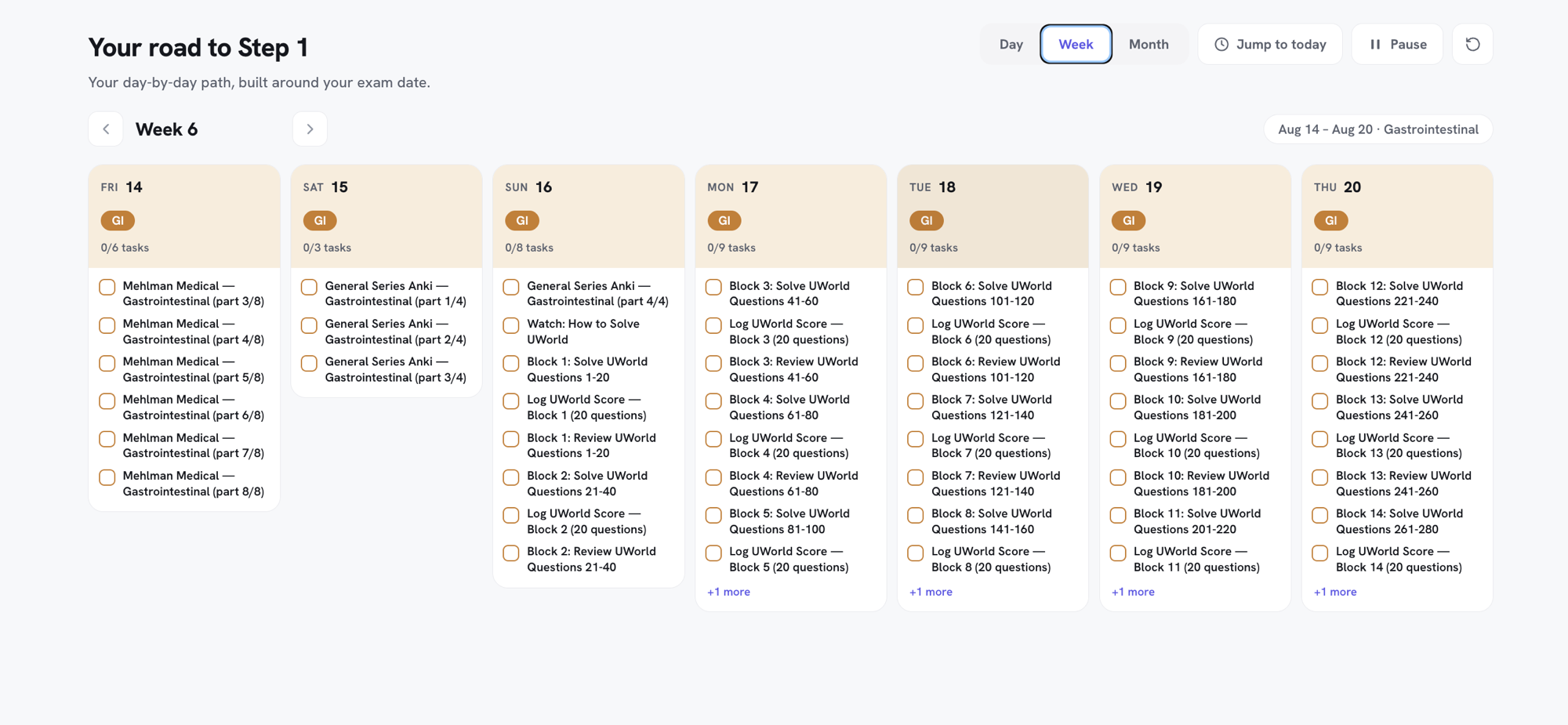 Build my schedule on usmlevault.com/schedule →
“Great explanation. Where does it live in First Aid?”
What is actually wrong: the teaching is fine. It is not anchored to the book, so you finish with slides and a book and no idea which to annotate — and your UWorld does not move a point.
Boards & Beyond is not a necessity. You don’t need it for every system, and most of you don’t need it at all.
“42% on my first block. I think I’m just not smart enough.”
What is actually wrong: UWorld is a learning and assessment tool, not a first-pass resource. Opened cold it measures nothing except that you have not read the system yet. My own first block was 50%.
Read the system before you open UWorldRenal is free in the First Aid Guide: every page, its explanation and its MCQs.
Open renal free →“I did about 70% of the system. I’ll do the rest later.”
What is actually wrong: the 30% you skipped was not held back — it was never opened. Those are the concepts that appear brand new during revision, when there is no time left to learn them.
“I took a baseline. It destroyed me for 2 weeks.”
What is actually wrong: forms are limited, and burning one cold, before your systems are finished, gives you a number you cannot act on and a fortnight of doubt you did not need. Even in my own run, 28 was the dip — 75%, between an 83 and an 83.
“50 questions, 75 minutes. Felt comfortable.”
What is actually wrong: the online format is spacious and inflates your score by 4–6%. You book a date on a number that was never real, and the pace you trained is not the pace of the exam.
“Got a 68. Onto the next one.”
What is actually wrong: taking another form without harvesting the last one is paying for the same diagnosis twice. The form told you in writing what it will ask again; most people read the number, feel something, and never open it.
Harvest every form you've givenThe NBME Booster Anki: forms 20 to 34 and the Free 120 as 1-line cards, sorted by system. Opens straight into the deck.
Open the NBME Booster →“Lecture notes for college, First Aid for USMLE.”
What is actually wrong: you studied the year once and now have to revise it twice. This is the single most expensive habit on the list, and it compounds for years.
“There’s no time. I’m on shift.”
What is actually wrong: you are waiting for a clean 6-hour block that is never coming, while 6 hours of dead time already exist inside your shift — unusable because UWorld is on a laptop at home.
“This week I’m locking in. For real this time.”
What is actually wrong: prep never collapses in a day. It leaks through quiet zero-days nobody witnesses, and the only person keeping score is you — and you are very easy to negotiate with.