For IMG interns who can't take time off, and will never get a clean 6-hour block on a shift.
By Dr. Marish Asudani · Published · Updated
How do I study for Step 1 during internship?
I finished Step 1 in 14 weeks during a full internship by keeping everything on my phone: UWorld, First Aid and the Sketchy PDFs. You need 6–8 hours a day, recovered in the gaps between rounds, not in 1 clean block. Phase 1: finish Sketchy Micro and Pharm in your lightest rotation. Phase 2: 2 days of First Aid per system, then UWorld with RPSR review. Phase 3: rapid review of all systems in 7 days, then the NBMEs.
I did not take time off. I did not wait for internship to end. The whole of Step 1 — content, UWorld, NBMEs, exam — ran inside a working internship, in 14 weeks.
My first UWorld block was around 50%. What changed that was not talent. I stopped treating the internship and the exam as competing priorities, and I let the dead time inside every shift become study time.
10 habits that got me through Step 1 in 14 weeks (underrated edition)
Nobody posts these. They're not resources and they're not hacks. They're the boring habits that made 14 weeks inside a working internship possible. Each one is explained in full further down this page.
UWorld on my phone. Not the iPad, not the desktop. A Q bank on a laptop at home is a Q bank you touch twice a week.
First Aid on my phone, 1 tap away. The moment a question exposed a gap, I could open that exact page. No waiting till I got home.
I never waited for a clean signal.40 minutes at a time, 6 to 10 times a day, plus a 2 to 3 hour study block after work. My 6 hours never came as 1 block. How I found the hours.
No Boards & Beyond. I started it, realised within 2 weeks it was a waste of my time, and stopped immediately. Far too slow for a working schedule, and not anchored to First Aid. That is how you learn from mistakes. Why it came off my list.
I always built a good base for a system before I touched its UWorld. Then I did UWorld system-wise, never random, and went back to the system: every miss went back into its First Aid page with the RPSR method. I started around 50%. With that review, blocks climbed to 70–80%. When a system is finished.
I always did the systems in a fixed order. Easy systems first, renal first, CNS and cardio last, biochem split in as small pieces. I did them haphazardly at the start and lost 2 weeks to it. The order, system by system.
This is my advice: don't plan your own days on a shift. If you want a day-by-day schedule, and to know exactly what to study next, go to the schedule section. It gives you a schedule built around your exam date and your hours.
1 · UWorld — on the phone. Not the iPad, not the desktop. This is the one people argue with and it is the one that matters most. You need to be doing questions constantly, and constantly means in the gaps: between rounds, waiting on a scan, the 20 minutes nobody accounts for. A qbank on a laptop at home is a qbank you touch twice a week. Any Q bank, but have it on your phone. The Q bank will help you.
📕
2 · First Aid 2026 — a copy on your phone, with a guide beside it. Your primary reference, always 1 tap away, so you can cross-check a concept the moment a question exposes it. And always have a guide on you that explains how to read First Aid. First Aid is important, and it reminds more than it teaches. The First Aid Guide on usmlevault.com does this natively: every page decoded, with that page's MCQs beside it. See a real page →
Read 1 renal page with the First Aid GuideRenal is free. Open it on your phone between 2 patients.
3 · Sketchy PDFs — micro and pharm, high-yield. On the phone for fast cross-referencing when an organism or a drug class comes up mid-block. You are not re-watching sketches; you are checking 1 image.
Both PDFs are free. They live in the University section on usmlevault.com/university, no email, no sign-up gate:
Sketchy Micro PDF — a system-wise breakdown of every topic, so you pull only the organisms for the system you are on.
High-Yield Pharmacology PDF — every high-yield drug by system, with the single best resource named against each one.
The principle: if a resource is not on your phone, during internship it does not exist. Build the whole stack around that constraint instead of fighting it. How to actually complete First Aid →
Know tomorrow's tasks tonight
Always divide your tasks. The night before, you should know what tomorrow's tasks are, so you wake up already knowing what to do. On a shift, the 40 minutes you get between patients should go to studying, not to deciding what to study.
1
Every night, write tomorrow's list. Which pages, which Anki deck, how many UWorld blocks. Small enough that you can finish it in pieces.
2
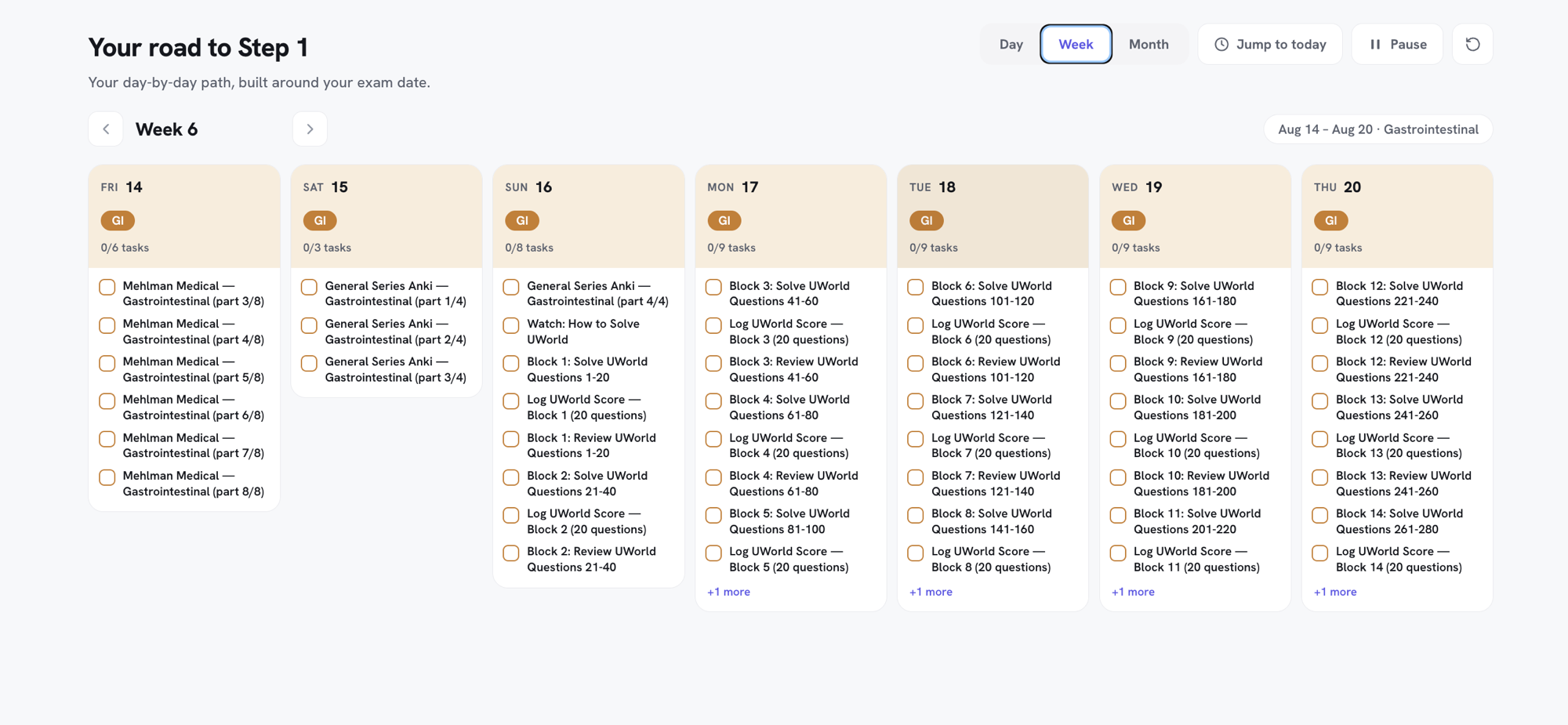
Or let the schedule do it. The schedule section of usmlevault.com gives you each day's task list: First Aid pages, Anki, UWorld blocks, videos, in order.
See tomorrow's tasks tonightYour day-by-day schedule, built around your exam date and your hours.
That is the screenshot above: 1 week of the schedule, every task in order.
Pick your real study hours
Most working people have just 5 to 8 hours a day. Be honest about yours. On the Vault schedule you pick your hours, and you get a task list curated for those hours, not for someone studying 12.
Tap the hours you really have on a working day. It opens the schedule.
The same content takes more calendar days at fewer hours. Roughly: 5 to 6 hours a day puts your exam about 6 months away, 8 hours about 4 months away, and 12+ hours about 12 to 14 weeks away.
Pick the option closest to the hours you really have on a working day. The schedule recalculates the calendar for that pace.
Have 8 hours a day and want your exam in the next 16 weeks? Put 7–8 hours into the schedule and it builds the days around your hours. The phases and the order of the systems are in the 16-week plan →
"You don't find 6 hours on a shift. You take them back, 40 minutes at a time, 6 times a day."Between rounds. Waiting on a scan. The 20 minutes nobody counts. That only works if everything is on your phone.
Finding 6 to 8 hours a day
You need 6–8 hours of study daily, which means cutting corners in the internship. I will say the uncomfortable part plainly.
⚖️
The internship alone will not get you there. Unless your only goal is to train locally with no exams, internship on its own prepares you for neither the USMLE nor a US residency. And even if you intend to stay and practise in India — the goal is still residency, and residency still requires clearing exams.
And you will genuinely learn more medicine from UWorld than from the hours you protect by not touching it. That is not a shortcut argument, it is a density argument — a UWorld block teaches more clinical reasoning per hour than most rotations do.
Keeping everything on the phone is what makes the arithmetic work. You are not finding a clean 6-hour block; you are recovering 40 minutes at a time, 6 times a day. Structure for that and the number is reachable. Structure for a quiet desk and it never is.
Phase 1 · Foundations — during your lightest rotation
🎬
Finish all of Sketchy Micro and all of Sketchy Pharm first. Completely, before a single organ system. Use whichever rotation is lightest — this is the phase that survives a busy posting worst, so spend the easy weeks on it.
Why front-loading these 2 pays off all year: when you reach an organ system later, you only have to revise that system's micro and pharm rather than learn them cold. Every system afterwards gets faster. Do it in the other order and every system carries 3 subjects instead of 1.
Front-loading Sketchy not working for you?
If doing a lot of Sketchy in one go isn't working for you, jump straight onto the systems. You do each system's micro and pharm right before that system anyway, so you can do them there instead of front-loading. Same lists, just placed system by system: every system's micro and pharm lists → · how to study any system →
End every day on the Vault, not on the video. Open the First Aid Guide → Microbiology in the left-hand navigation, and run the MCQs for the exact pages you covered that day:
Day
Block
First Aid pages
Day 1
DNA viruses
pp. 160–163
Day 2
RNA viruses
pp. 164–173
Day 3
Parasites
pp. 152–158
Day 4
Fungi
pp. 149–150
Day 5
Gram positives
pp. 132–137
Day 6
Gram negatives, atypicals & spirochetes
pp. 139–148
Do this the same night, not the next morning. By the end of the day each organism has been hit 4 times in 4 formats — video, sketch PDF, First Aid page, then questions. Target: 70%+ on that day’s MCQs. Full protocol: Sketchy Micro in 6 days.
2 days reading First Aid for the system. Read it with ChatGPT and high-yield YouTube open beside you for anything that will not click. Avoid Boards & Beyond — it is far too time-consuming for a schedule like this, and it is not anchored to the book. Why B&B, Kaplan, Rx and Pixorize came off my list →
I built a page-by-page index of the high-yield topics, the ChatGPT prompts and the YouTube links for each one — which is exactly what the First Aid Guide now does for all 646 pages, with the best video already attached and MCQs on the page itself.
2
Then straight into UWorld blocks, with a review protocol. Not a casual read of the explanations — a protocol. I started at around 50%. With aggressive, detailed review, blocks climbed to 70–80%.
Do the systems in a deliberate order. I approached them haphazardly at the start and lost 2 weeks to it. Renal first, CNS and cardio last, biochem split in as prerequisites rather than crammed as a block.
Any Q bank works. But when you want to learn how to solve the Q bank, how to solve the NBMEs, or how to solve anything, go to the University section of usmlevault.com. Learn how to solve, not just what to solve.
Rapid review — all systems in 7 days. First Aid text plus a high-yield Anki deck for active recall. I built my own deck for this; it became the Foundation Anki deck — the whole of First Aid page by page, 2,499 cards (as of October 2026), about 400 a day.
Open the FA Foundation AnkiThe whole of First Aid, page by page, as cards. Opens straight into the deck.
Then the forms. This is what mine actually looked like:
Form
How
Score
NBME 26
Full form
77%
NBME 27
In blocks
83%
NBME 28
In blocks
75%
NBME 29
After reviewing the Mehlman high-yield PDFs
83%
Free 120
Then the exam
Passed
Read the 28 row carefully. 28 is one of the hardest forms and the score dropped — that is normal and it is why it belongs in blocks rather than as a full form. The fix was not more questions; it was the Mehlman high-yield PDFs, and the next form went straight back up. How to use Mehlman → · When the number will not move →
Every NBME is taken offline. The online version gives you 50 questions in 75 minutes; it feels spacious and inflates your score by 4 to 6%. Offline, you give 20-question blocks of 30 minutes, the pace of the real exam. NBMEs offline, the full system → For Step 1, only the trend on NBME 31, 32 and 33 predicts readiness: 68%+ on all 3 before you schedule. The Free 120 is practice, not a predictor. How to know you're ready →
The complete ordering — which form, when, in blocks or full, and what each one is for — is in the exact NBME order.
Do this today: put UWorld and First Aid on your phone before you do anything else. Then open usmlevault.com → First Aid Guide → the Renal system is free → read 1 page between 2 patients. That single page tells you whether this is possible for you. It is.
 Build my schedule →