How to Use Mehlman Medical
For IMGs with a folder full of Mehlman PDFs and a score that won't move.
By Dr. Marish Asudani · Published · Updated
When should I use Mehlman Medical videos for Step 1?
In every system. Mehlman is a fixed step: micro and pharm from the First Aid Guide pills, then active reading with the First Aid Guide, then that system's Mehlman playlist, then the FA Foundation Anki, then UWorld. Budget about 1 day for the playlist. Watch the videos, not the PDFs, because the videos teach how the NBME frames the stem and how to eliminate the wrong options. Short on time? Sort the playlist by date and watch the latest 3 years first.
Most IMGs misuse Mehlman completely. Used wrong, it's hours of passive watching that doesn't move your score. Used right, it's the day where First Aid turns into the way the NBME actually asks it.
Mehlman is a fixed step in every system. Not a rescue you save for later. Everything below is how to run that one step properly, and Rule 3 shows exactly where it sits.
The Value Is in the Videos, Not the PDFs
The single biggest mistake: thinking Mehlman's value is his PDFs. It isn't. People download every PDF, feel productive, and never improve. The value is in his videos.
They're short, 5-minute clips where he doesn't just teach you the answer — he teaches you how the NBME thinks about a question: how it frames the stem, how it builds the options, and how to eliminate the wrong ones. That elimination skill is the part that actually moves your score. A PDF gives you facts; the video gives you the exam's reasoning.
Collecting Mehlman PDFs is not studying. Watch the videos. The PDFs are a reference at best. They are not the resource.
The one Mehlman PDF that is worth it: the HY Arrows
One Mehlman document is different. The High-Yield Arrows is not a playlist and not a per-system resource. It's a single dense document covering every system at once, built around the up-arrow and down-arrow relationships the exam keeps asking about.
Keep it open the whole way through your prep, and run it hard the week an NBME stops moving. It's the highest-yield thing available in a plateau.
Open the Mehlman HY Arrows, free in UniversityThe 1 Mehlman PDF worth keeping, next to the Neil Randy PDF in the free PDF section.
Open University →Every other free PDF, and when each one comes in: The Seven Sheets.
Use the System-Wise Playlists
His system-wise video playlists are the single best resource on the internet to revise an entire system's high-yield in one day. And you don't just memorize what's high-yield — he makes you understand why it's high-yield, which is what makes it stick.
Mehlman is blunt, direct, and honestly a little rude. That's not a bug — it's the feature. That bluntness is exactly what finally stops students from repeating the same mistakes on exam day. Let it land.
So the move is simple. Don't watch random videos. Run that system's full playlist, start to finish, in order, in about 1 focused day. Half a day if you're fast, 1 day if you're thorough.
Short on time? Sort the playlist by date and watch the latest 3 years first. That's exactly what Dr. K did in the clip above.
Read the system before you press playMehlman lands best on pages you have already read. The First Aid Guide takes you through every page of a system with its MCQs. Renal is free.
Open renal free →Every System, Not Just the Weak Ones
Mehlman is not something you save for a system that has already gone wrong. You watch him in each and every system, as the active application step, right after you have read that system with the First Aid Guide.
Why that point in the system? Because by then you have read the pages and tested them with the page MCQs. Mehlman takes those same pages and shows you how the NBME turns them into a stem and 5 options. Then the FA Foundation Anki locks the lines in, and UWorld lands on a primed brain.
From the pills on the First Aid Guide. Day 1. Micro by system → · Pharm in 48 hours →
Page by page, with the MCQs on every page. How to read First Aid →
That system's playlist, in order. About 1 day.
That system's deck, about half a day. How to run it →
Read, pre-solve, solve, review. The RPSR method →
Want a day-by-day schedule that tells you exactly what to study next? The Vault builds it around your exam date.
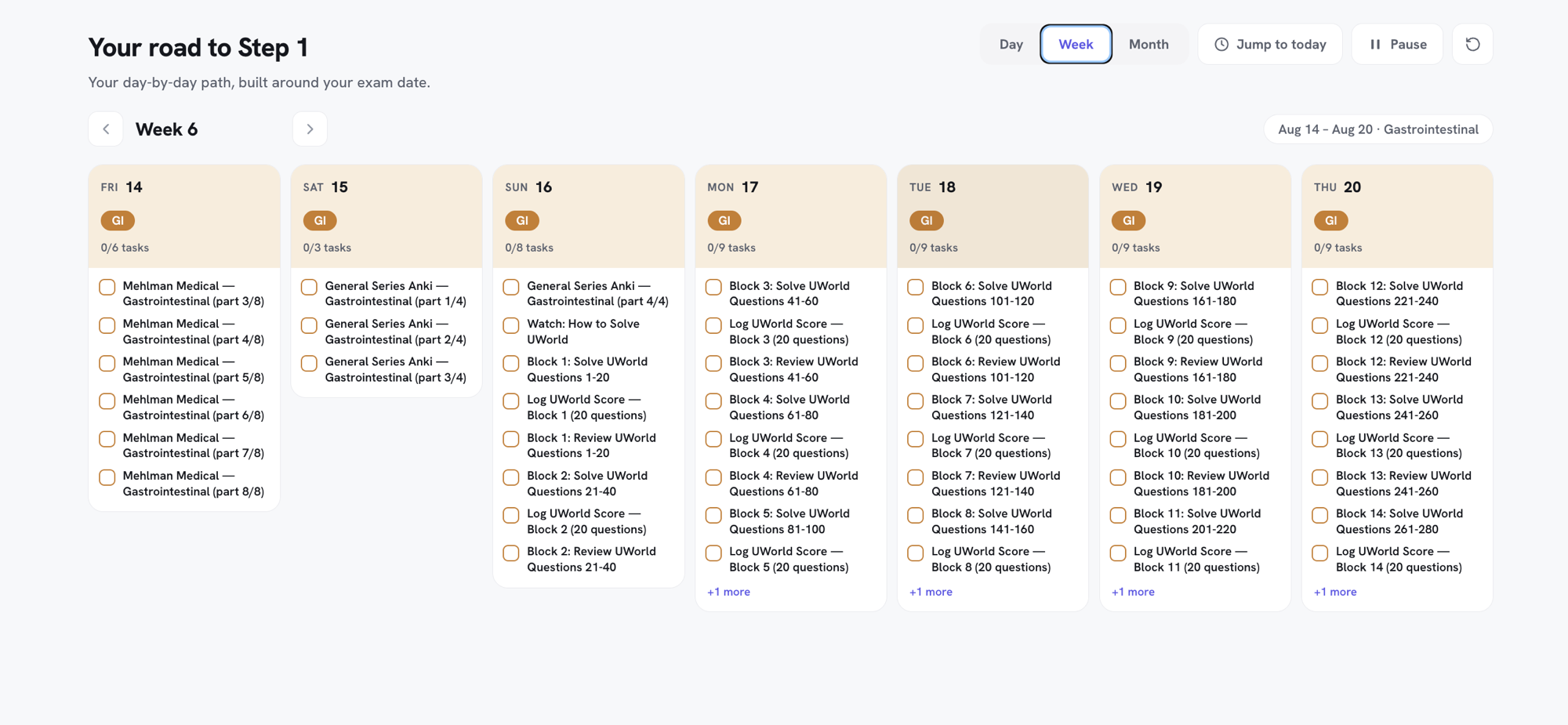 Build my schedule on usmlevault.com/schedule →
Where It Sits, and What to Avoid
Put the 3 rules together and Mehlman becomes 1 planned day per system, not a 200-hour rabbit hole:
Every system. Same slot every time, so you never decide whether today is a Mehlman day.
Find the relevant video. 5 minutes on the mechanism beats rereading the same First Aid box again.
Sort the playlist by date and watch the latest 3 years first. Older years later, if the system is weak.
That's the trap from Rule 1. Watch the videos. The HY Arrows is the only exception.
Run the system you're on, in order. The playlist list is right below.
Which Playlist When
One playlist per system, in the order the Vault schedule runs them: easy systems first, cardio last. Open the one for the system you're on, the day after you finish its First Aid Guide pages. Watch this first:
▶How to watch Mehlman Medical videos10 minutes. Before your first playlist.After the playlist: that system's FA Foundation AnkiFirst Aid lines as cards, the page number on every card. Opens straight into the deck.
Open the deck →Renal, day by day: Renal in 6 days. The order of every system, and a guide for each: How to study a system →. Mehlman also has micro, pharm, biochem, immunology and Step 2 CK playlists. The ones worth your time outside the systems are in 6 playlists = 6% growth.
How to Run a Playlist
Micro and pharm from the pills, then active reading with the page MCQs. Mehlman comes after that, every system.
Watch the videos in order, not random clips. The University section on usmlevault.com has a walkthrough video showing exactly how to run his playlists. Short on time: sort by date, latest 3 years first.

Pay attention to how he eliminates options and how the NBME frames the trap. That's the transferable skill.
Lock the system in with its FA Foundation Anki cards, then open that system's UWorld. The questions land on pages you have now hit from 4 different angles.
Watch how to run a Mehlman playlistThe walkthrough video in University shows exactly how to run his playlists, next to the free Mehlman HY Arrows and Neil Randy PDFs.
Open University →By the end of 2 to 3 days you have attacked the same First Aid pages 4 to 5 different ways: read, tested, applied with Mehlman, recalled with Anki. That is why UWorld moves.
Non-Negotiables
The reasoning lives in the videos. PDFs are reference only.
Not scattered clips. 1 system's high-yield in about 1 focused day.
After the First Aid Guide, before the FA Foundation Anki and UWorld.
Sort by date. Go back to the older years for your weak systems.
Mehlman is one layer of the USMLE Vault system: the active application day of every system, and the playlist is already placed on your schedule. The page-by-page reading, MCQs, schedule, and Anki are on usmlevault.com. 👉 Start on usmlevault.com/university — FREE for your first 3 days →
ELI5, Test Yourself and Rule out — every page teaches twice, and now teaches elimination.
Read next
Stuck at 62-65% — the 3 moves that break a plateau.
The exact NBME order — which form to give, and when.
How to actually complete First Aid — the 4-reading method, 4-5 days a system.
Boards & Beyond: still worth it? — when to watch it, and the faster system method.
6 playlists = 6% growth — the Step 1 playlists worth your time.
5 channels = 0 paid courses — which channel, in which phase.
The tier lists — resources, YouTube, qbanks, micro, Anki, pharm.